

A Portable Lab At Your Fingertips
DxHub is a compact, field-ready molecular testing system ideal for bringing isothermal assays to where they are needed most.
Prepare your assay tube, insert it into a test bay, and let DxHub do the rest.
Flexible Testing Capabilities
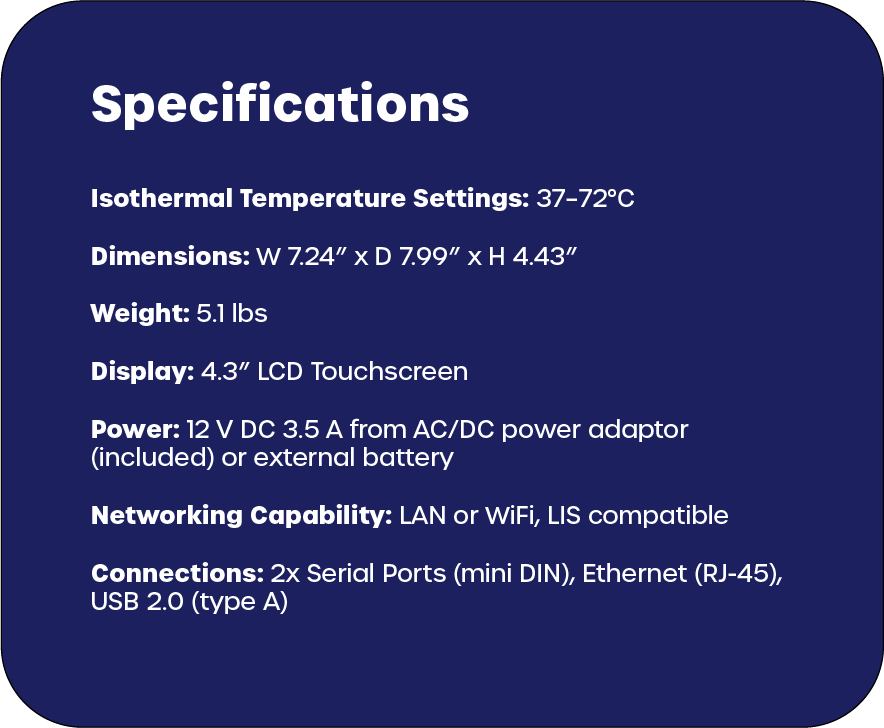
-Compatible with DxTests and any other isothermal assays
-Asynchronous processing of up to 8 tests using random-access test bays
Intuitive Plug-and-Play Operations:
-Standalone operation with no end-user calibration or routine maintenance needed
-Fully automated reaction control and signal analysis eliminates the need for laboratory experience or specialized training
Built for Even the Most Challenging Settings:
-Full operation with mains electricity or external battery power
-Ruggedized to withstand rough transport and use in harsh environments
Easy Input and Output:
-Serial interface for barcode scanner and printer
-Secure data transfer over LAN or WiFi, compatible with Laboratory Information Systems (LIS)

DxTests: Rapid, Accurate, Affordable Molecular Tests
Explore our point-of-care tests built for use with DxHub
Case Study: How Researchers at the Broad Institute of MIT and Harvard Used DxHub to Field-Evaluate a CRISPR-Based Mpox Assay During the 2025 Sierra Leone Outbreak
Mpox SHINE, a CRISPR-Cas13 assay developed by the Sabeti Lab, was deployed to Sierra Leone on DxHub for in-country evaluation across 72 clinical specimens — achieving 100% concordance with the qPCR reference standard.
Title
Rapid development and field evaluation of a portable CRISPR-based assay for Mpox during the 2025 Sierra Leone outbreak
Abstract
The large 2025 Mpox clade IIb outbreak in Sierra Leone underscores the urgent need for portable, low-cost diagnostics in decentralized settings. While CRISPR-based assays offer high sensitivity and flexibility, their deployment during active outbreaks remains limited. Here we show the rapid development and field evaluation of Mpox SHINE, a CRISPR–Cas13 assay that integrates lyophilized reagents, ambient-temperature lysis, and automated fluorescence detection on the portable DxHub device. The assay achieves analytical sensitivity down to 10 copies/µL. Clinical validation in Sierra Leone, using 56 clinical specimens, confirms complete concordance with qPCR, demonstrating 100% sensitivity and 100% specificity. Crucially, Mpox SHINE also detects the virus directly from unextracted lesion swabs while maintaining 100% sensitivity and specificity. The mean time-to-result is fast, averaging 11.4 minutes for extracted samples and 27.9 minutes for unextracted samples. These findings demonstrate that CRISPR-based diagnostics translate quickly from genomic sequence to clinically validated, deployable tools within a single outbreak window.